
From the deserts of the Middle East to the coastlines of Africa and the former coal belts of Europe, one of the biggest revolutions in global energy is happening right before our eyes: the rise of solar photovoltaics (PV).
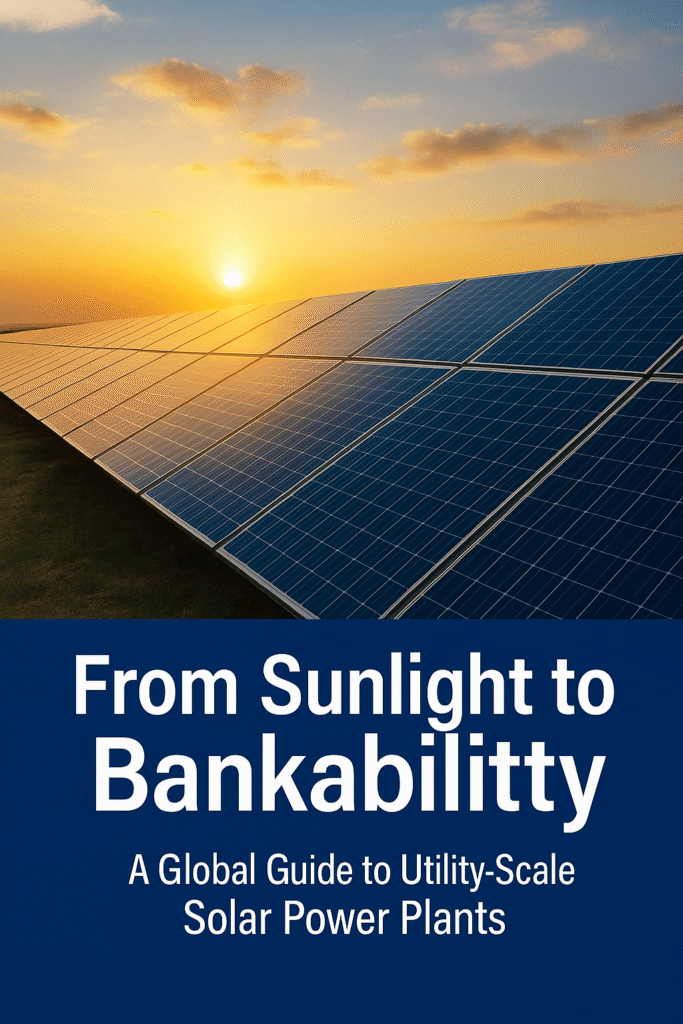
In 2023 alone, the world added 450–500 GW of new PV capacity, representing nearly three-quarters of all renewable power additions. By the end of the same year, global installed capacity surpassed 1.6 terawatts, making solar energy not just a clean alternative but a central pillar of modern electricity systems.
But behind these spectacular numbers lies a more complex reality.
Developing a large-scale, bankable, socially responsible solar project requires technical expertise, financial rigor, environmental planning, and strong stakeholder engagement.
This is exactly why the new comprehensive book on utility-scale solar project development is a must-read for anyone serious about the future of energy.
Why Solar PV Has Become the World’s Fastest-Growing Energy Source
Solar power is now one of the cheapest forms of electricity. Global costs keep falling—the weighted average LCOE dropped by 12% in 2023—despite inflation and supply-chain pressures.
Solar now competes:
- Without subsidies
- Against new fossil-fuel plants
- And in some regions, even against the operating costs of existing coal and gas plants
This explosive growth is driven by:
✔ Rapid construction timelines
Large PV plants can be built in 9–18 months.
✔ Modularity
Plants can scale from 10 MW to massive 500 MW+ parks.
✔ Low operational risk
No fuel. Minimal maintenance. Predictable performance.
✔ Strong political & public support
Solar aligns with global net-zero strategies.
Yet, as the book clearly shows, developing a credible, bankable solar project goes far beyond simply “putting panels in the sun.”
What This Book Brings: A Complete Journey From Idea to Operating Megawatt
This book is not a theoretical overview — it is a practical guide built from real-world experience.
It walks you through every stage of a utility-scale solar project:
1. Understanding Solar Resource and Site Conditions
Learn how to interpret GHI, DNI, climate zones, shading, terrain, and environmental constraints — all crucial aspects highlighted in the book’s technical chapters.
🔹 2. Technology Choices: Modules, Inverters, Trackers
The book explains:
- Fixed-tilt vs. single-axis tracking
- Monofacial vs. bifacial modules
- Central vs. string inverters
- PV-only vs. PV-plus-storage
Knowledge that directly impacts yield, reliability, and LCOE.
🔹 3. Grid Connection & Power System Integration
A successful project depends on the grid.
You will learn how to assess:
- Substation capacity
- Transmission distances
- Grid code requirements
- Curtailment risk
- Network stability
These topics appear throughout the book’s engineering sections.
🔹 4. Environmental & Social Impact (ESIA)
The book details best practices for:
- Protecting flora & fauna
- Managing community expectations
- Preserving cultural heritage
- Applying IFC Performance Standards
- Designing stakeholder consultations
This is essential for lenders and regulators.
🔹 5. Commercial Strategy & Offtake Structures
From PPAs with state utilities to corporate offtakers and traders, the book explores:
- Power markets
- Time-of-day value
- Corporate PPAs
- Hybrid systems (PV + storage + diesel + hydro)
- Demand patterns & the famous duck curve
It provides actionable guidance to secure a bankable revenue model.
🔹 6. Financial Modelling & Risk Analysis
Clear explanations of:
- IRR, NPV, WACC
- P50/P75/P90 estimates
- CAPEX vs. OPEX drivers
- Construction risk
- Currency and political risks
A full toolbox for building models that financiers trust.
🔹 7. Pre-Feasibility & Feasibility Studies
One of the book’s strongest parts explains how to turn a simple idea into a well-structured, investment-ready project — and avoid the pitfalls that kill most solar proposals.
Who Should Read This Book?
✔ Solar developers
✔ Energy investors and project financiers
✔ Engineering firms & EPC contractors
✔ Government agencies and regulators
✔ NGOs and environmental specialists
✔ Students and researchers in renewable energy
If you want to understand how utility-scale solar plants really work, from concept to operation, this book is your roadmap.
Final Thoughts: Solar Is the Future — This Book Helps You Build It
The global solar revolution is accelerating faster than ever. But successful solar projects don’t happen by accident.
They are the product of expert planning, robust engineering, responsible social engagement, and solid financial design.
This book gives you all the tools, insights, checklists, and frameworks needed to develop world-class solar PV projects — even in challenging markets.
👉 Add it to your energy library today and stay ahead of the solar transformation. Here
